
Australia Day
A National Holiday at the Crossroads
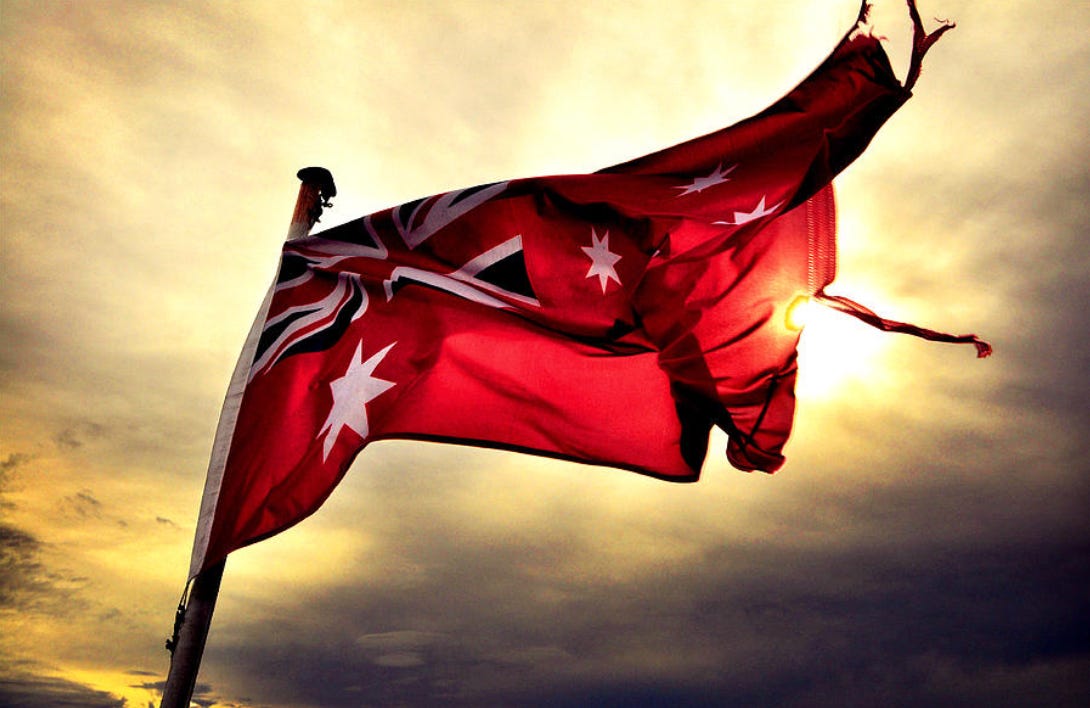
Australia Day, observed on January 26, marks the anniversary of the 1788 arrival of the First Fleet at Port Jackson and the raising of the British flag at Sydney Cove. What began as a colonial commemoration has evolved into Australia’s official national day, yet it remains one of the country’s most contested public holidays.
For Aboriginal and Torres Strait Islander peoples, January 26 represents the beginning of colonization that brought devastating consequences to their communities. The arrival of the First Fleet initiated dispossession from ancestral lands, the disruption of cultures that had thrived for over 65,000 years +, countless massacres, forced removal of children (the Stolen Generations), and the imposition of policies designed to eradicate Indigenous cultures.
Not exactly something to “celebrate.”
Many Indigenous Australians (rightly) refer to the date as “Invasion Day,” “Survival Day,” or a “Day of Mourning.” The resentment isn’t simply historical—it’s deeply personal and ongoing.
Indigenous Australians continue to experience significant disadvantage in health outcomes, incarceration rates, life expectancy, and economic opportunity. Just look at how they were treated (aka abused) during the pandemic! Celebrating the date that marked the beginning of this dispossession feels, to many, like being asked to celebrate their own trauma.
Those who support keeping Australia Day on January 26 often argue from several positions. Some view it as marking the foundation of modern Australia and the democratic institutions they value. Others see changing the date as “erasing history” or succumbing to political correctness. For many, it’s simply tradition—a summer holiday for barbecues, cricket, and community events that has no malicious intent.
Some people genuinely don’t connect the celebration with Indigenous suffering, viewing it instead as celebrating what Australia has become: a multicultural democracy. The attachment is often less about the specific historical event and more about the rituals and national identity that have grown around the day over generations.
But like many cultural flashpoints globally, Australia Day has become a proxy battle for broader anxieties about identity, history, and social change. Media coverage often amplifies the most extreme voices on both sides, creating a false binary: you either love Australia and support January 26, or you’re ashamed of the nation and want to tear down its achievements. And of course, as is typical nowadays with any social commentary, they roll out the obligatory celebrities to support and justify their message, siphoning as much energy as they can from those who still pay attention to actors playing activist.
However, this dualistic framing is both inaccurate and destructive. It turns a conversation about inclusivity and historical acknowledgment into a dangerous culture war, where nuance becomes impossible and listening to others’ experiences is seen as weakness or betrayal.
And let’s be brutally honest for a moment here: the last few years of pandemic madness haven’t done much to curate national unity have they? If anything, they’ve broken (or at least severely crippled) the Aussie spirit.
Various groups—political parties, media outlets, activist organizations—have exploited the growing controversy to mobilize supporters, raise funds, or score political points, often at the expense of genuine reconciliation or understanding.
And here’s what troubles me most about the Australia Day debate: it’s become yet another example of how our voices as everyday Australians seem to matter less and less.
We’ve watched our rights and freedoms steadily eroded in recent years—increased surveillance powers, restrictions on protest, mandatory data retention, heavy-handed responses to dissent, to name a few. The “democracy” we’re supposedly celebrating on January 26? It’s looking pretty hollow these days.
And that’s the bitter irony, isn’t it? People defend Australia Day by talking about our democratic values and freedoms, while those very things are being dismantled—in the background and right in front of our faces. We’re told to wave the red-white-and-blue (a flag that only cements our allegiance to their corrupt system, by the way) and fire up the barbie… while our civil liberties get chipped away. Often with bipartisan support.
So, when it comes to changing the date—something that would cost nothing, harm no one, and potentially help heal some deep ancient wounds in this country—do I think the government will actually listen to Indigenous Australians or the growing number of embodied people who see this as a necessary step? Not really. Because doing what serves the people, what’s compassionate and unifying, doesn’t seem to be on the agenda anymore.
The Australia Day debate has become just another wedge issue that politicians and media use to keep us divided and distracted. Meanwhile, the substantive issues—Indigenous disadvantage, inequality, the erosion of our democratic institutions—get pushed to the sidelines. We’re fighting about the date of a holiday while the country we thought we knew slips further away.
The fundamental issue remains whether a nation can truly unite around a date that causes genuine pain to its First Peoples. Many countries celebrate their national days on dates that are inclusive rather than divisive—marking federation, independence achieved through self-determination, or moments of unity rather than conquest.
Australia has other options: Federation on January 1st (though it conflicts with New Year’s Day; another Gregorian imprint), the anniversary of the 1967 referendum when Australians voted to include Indigenous people in the census, or an entirely new date chosen specifically to represent all Australians.
The harm isn’t just symbolic either. Each year, the debate reopens old wounds, forces Indigenous Australians to justify their pain, and positions non-Indigenous Australians as having to choose between patriotism and empathy—a false choice that benefits no one.
Look, the most compelling argument for change isn’t about erasing history—the significance of January 26 wouldn’t just disappear—but about choosing what we actively celebrate as a nation. We can acknowledge the arrival of the First Fleet in history books and museums while selecting a national day that allows all Australians to participate without asking any group to swallow their grief.
And perhaps at the same time, we can stop pretending the British Empire had any jurisdiction—legally, physically, or spiritually—over any of the cultures they claimed for themselves “in the name of God.”
True national unity requires the humility to listen when people say, “this hurts us,” and the creativity to find solutions that don’t require anyone’s pain as the price of admission. The question isn’t whether Australia has things worth celebrating—it clearly does—but whether we can find a way to celebrate that doesn’t require some Australians to endure a national party held on the anniversary of their ancestors’ dispossession.
Whether our current political system has the will or integrity to make that happen? That’s another question entirely. But maybe that’s exactly why conversations like this matter—because change has always come from people demanding better, not from governments graciously offering it.
NB For those of you collecting your citizenship certificates this weekend at numerous ceremonies held across the country, know that all you are doing is signing up for (continued) serfdom. You’re just on different soil now. That goes for anywhere in the world, not just here. The term “sovereign citizen” means absolutely nothing. It is a complete contradiction in terms, one that has been manufactured by mainstream media, and one that any true living man or woman realizes as fake, false, fraudulent. We surrender our natural God-given rights, when we sign up to be citizens of the state.
Whatever you choose to do this weekend, may it be anchored in love, peace, compassion, reciprocity, and a deepening respect for all Australians as co-creators and co-custodians of this great southern land.
On any day of the year.
AHO